AI search is no longer emerging. It’s here, and it’s reshaping how people find businesses.
AI search stopped being a curiosity somewhere in the last eighteen months and became infrastructure. As of mid-2026, 37 percent of consumers begin their searches with an AI tool rather than a traditional search engine, ChatGPT has passed one billion monthly active users, and Gartner’s prediction that traditional search volume would fall 25 percent by late 2026 no longer looks aggressive. This report pulls together the most current data available on how AI search actually works in 2026: who’s winning the platform race, what’s happening to clicks, how consumers behave inside AI answers, and what it means for the businesses trying to get found.
Who Is Winning the AI Search Platform Race in 2026?
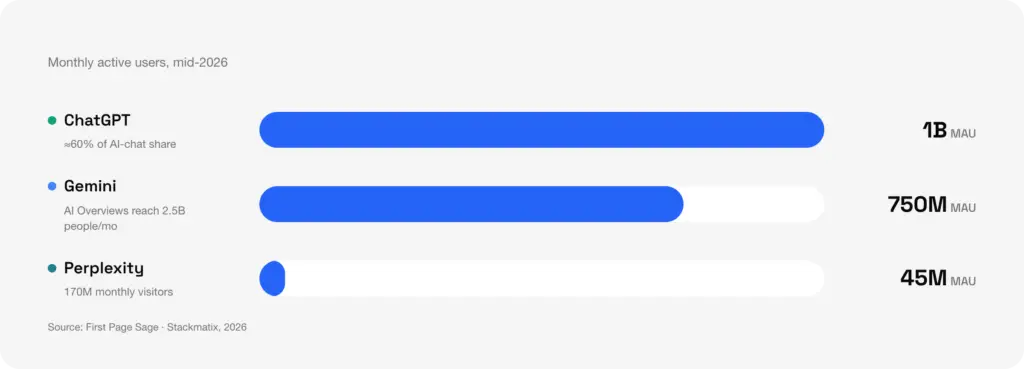
ChatGPT remains the dominant AI assistant, holding roughly 60 percent of global AI-chat share and hitting one billion monthly active users in May 2026, the fastest any app has reached that milestone. But the gap behind it is closing fast.
Gemini reached 750 million monthly active users and more than doubled its share of chatbot web traffic year over year, helped by the distribution advantage of Google surfaces: Gemini-powered AI Overviews now reach roughly 2.5 billion people a month. Perplexity sits at over 45 million monthly active users with around 170 million monthly visitors, and Claude has carved out a meaningful position in professional and B2B contexts.
Query Volume Tells the Real Story
The more useful frame than market share is query volume. Google still handles roughly 80 percent of total global queries. But AI platforms are now absorbing an estimated 15 to 20 percent of informational query volume, and search-related AI usage has grown to roughly 28 percent the size of traditional search worldwide.
The informational query, the “what should I look for,” “who’s the best,” “how does this work” question, is exactly the query type that historically fed business discovery. That’s the segment moving fastest.
What Is Happening to Clicks?
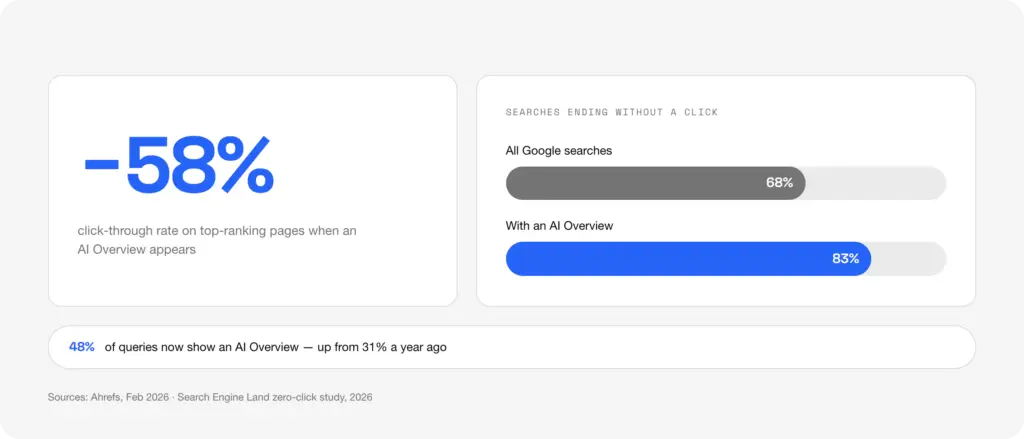
The most consequential data of 2026 concerns what happens after a search. An Ahrefs study published in February 2026 found AI Overviews correlate with a 58 percent reduction in click-through rate for top-ranking pages, nearly double the decline documented in April 2025. Seer Interactive measured organic CTR falling from 1.76 percent to 0.61 percent on queries where an AI Overview appears. A separate analysis of 68,000 real queries found users clicked results 8 percent of the time when an AI summary appeared, versus 15 percent without one.
Zero-Click Is Now the Default
Zero-click behavior has climbed in step. Sixty-eight percent of US Google searches now end without a click, and on queries with an AI Overview, that figure reaches roughly 83 percent. AI Overviews themselves now appear on about 48 percent of tracked queries, up from 31 percent a year earlier. Google search referral traffic to publishers declined by roughly a third in the year to November, a drop steep enough to trigger both product changes from Google and antitrust litigation from publishers.
Being Cited Flips the Math
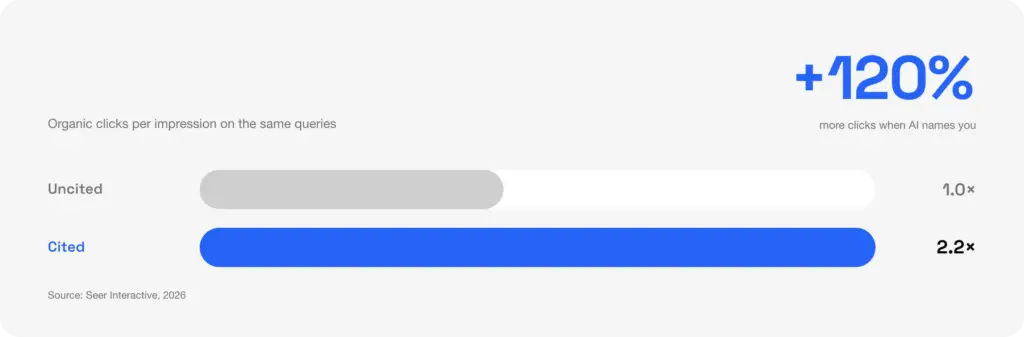
The critical nuance: citation changes everything. Seer Interactive’s 2026 analysis found brands cited inside AI Overviews earn approximately 120 percent more organic clicks per impression than uncited brands on the same queries. The traffic isn’t disappearing evenly. It’s concentrating on whoever the AI names.
How Are Consumers Actually Using AI Search?
Adoption keeps climbing: 70 percent of consumers say their AI use for search increased over the past year, and only 4 percent have never used AI for search at all. Nearly 43 percent of global consumers used an AI tool for a local search in the past month.
The Trust Correction
But 2026 also produced the first clear trust correction. In 2025, 82 percent of consumers said AI was more helpful than traditional search; in 2026 that figure fell to 54 percent. The share of consumers saying heavy AI use by a brand would reduce their trust rose from 20 to 39 percent. And 85 percent of AI users still double-check answers elsewhere.
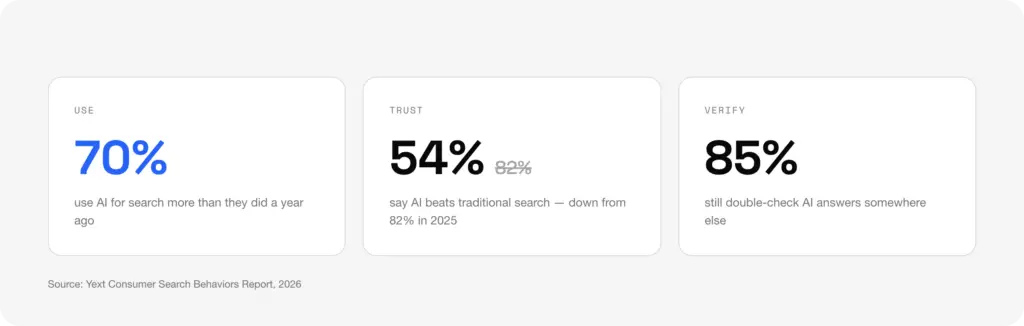
For businesses, this cuts in a specific direction. Consumers haven’t stopped using AI answers; they’ve started scrutinizing them. That raises the value of being the verifiable answer, the business whose presence holds up when the user cross-checks, and raises the cost of thin or inconsistent information across the web.
Commerce Moved Inside the Answer
The other structural shift of 2026 is transactional. In February, OpenAI relaunched “Buy it in ChatGPT,” connecting more than a million Shopify merchants and adding PayPal as a payment layer, which moved AI search from recommendation into checkout.
AI-referred retail traffic grew 393 percent year over year in early 2026 and now converts roughly 42 percent better than non-AI traffic, a full reversal from a year earlier when it converted worse. During Cyber Week 2025, Salesforce measured AI and agents influencing $67 billion in global sales, touching roughly one in five orders worldwide.
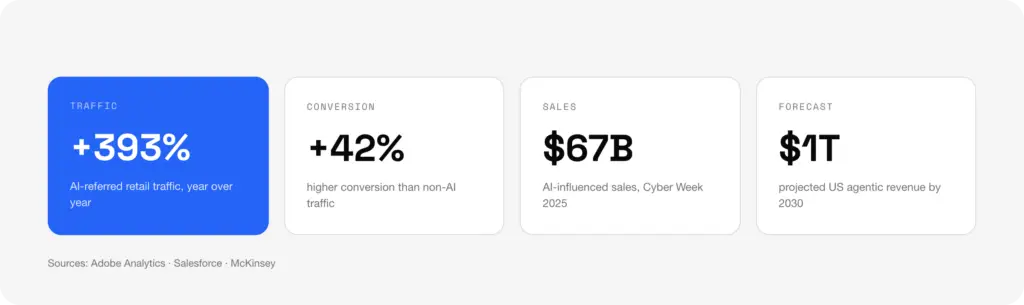
eMarketer projects US agentic commerce at over $20 billion in 2026, and McKinsey projects up to $1 trillion in US B2C retail revenue flowing through agentic channels by 2030. The recommendation and the transaction are collapsing into the same surface. Whoever the AI cites doesn’t just get the visit anymore. Increasingly, they get the sale.
The Visibility Gap Is the Defining Problem
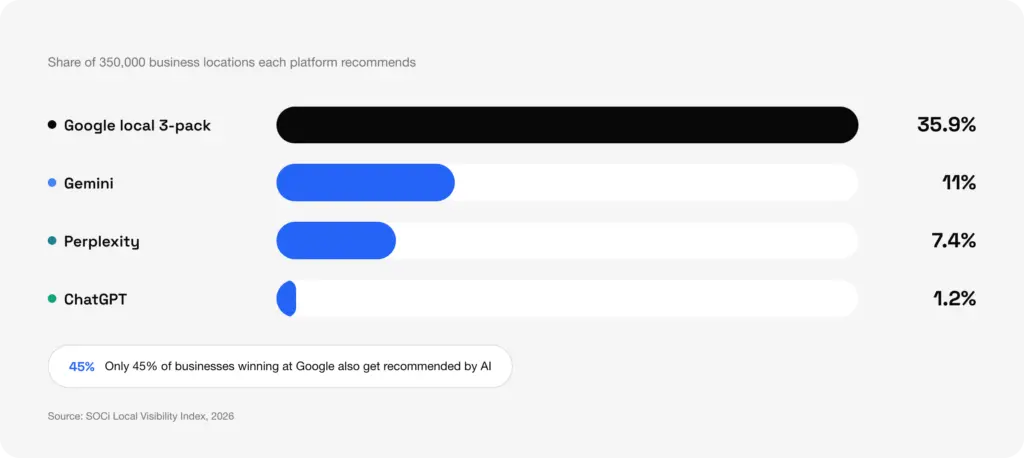
Set against all of this growth is the most underappreciated statistic of the year: almost nobody is visible. SOCi’s 2026 Local Visibility Index, which analyzed nearly 350,000 business locations, found ChatGPT recommends just 1.2 percent of them. Gemini recommends 11 percent, Perplexity 7.4 percent. Google’s traditional local three-pack, by comparison, surfaces 35.9 percent.
Earning AI visibility is roughly 3 to 30 times harder than earning traditional local search visibility, and the overlap between the two is thin: only 45 percent of brands that perform well in traditional local search also get recommended by AI.
That last number deserves emphasis. More than half of the businesses winning at Google are absent from AI answers. Ranking and being recommended have become different games, played by different rules, and most businesses are only playing one of them.
What This Adds Up To
The 2026 picture is coherent once assembled. Query volume is migrating to AI platforms fastest in exactly the categories where buying decisions start. Clicks are consolidating on cited businesses while everyone else absorbs the zero-click decline. Consumers are scrutinizing AI answers more, which rewards businesses with verifiable, consistent presence. Commerce is moving inside the answer itself. And the bar for being the answer remains brutally selective, with the overwhelming majority of businesses invisible to the platforms their customers now ask first.
The businesses that treat AI visibility as a distinct discipline, measured, tracked, and built deliberately rather than inherited from Google rankings, are competing for a surface most of their market hasn’t noticed yet. That window is the real story of 2026, and it will not stay open indefinitely.
See Where Your Business Stands
See where your business stands with a free AI visibility score at cytd.ai.
See how AI sees your business
Enter your domain and get a free Cytd Score in under 30 seconds — you will see how ChatGPT, Gemini, Perplexity, Claude and Grok currently describe your business. No credit card required.
Get your free AI Visibility Report