

Your Cytd Score Explained
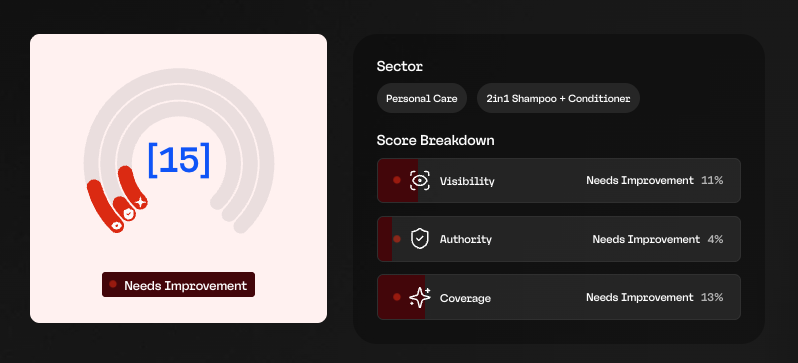
Your Cytd Score is a number from 0 to 100 that represents how likely AI systems are to cite your business when someone asks about the products or services you offer. It’s built from three factors, and once you understand what each one measures, the score becomes easy to read on your own. Here’s how it works.
What the Score Actually Measures
When someone asks ChatGPT or Gemini a question like “who’s the best dentist” AI has to decide which businesses to include in its answer. Your Cytd Score measures how likely that decision is to go your way. A higher score means AI platforms have more reason to trust and reference your business. A lower score means they either don’t know enough about you or don’t yet trust what they know.
It’s worth being clear about what the score is not. It isn’t a Google ranking, it isn’t a traffic number, and it isn’t a grade on how your website looks. A business can rank first on Google and still have a low Cytd Score, because AI systems evaluate different signals than search engines do. That gap is exactly why the score exists.
The Three Factors
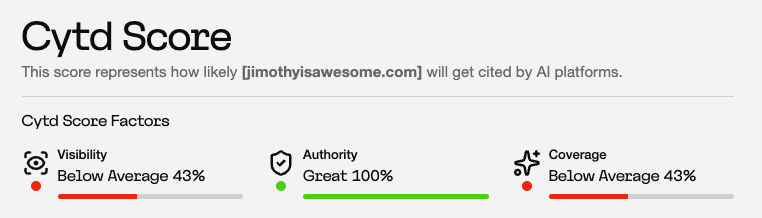
Your score is built from three factors: Visibility, Authority, and Coverage. Visibility carries the most weight, followed by Authority, then Coverage.
Visibility
Visibility measures whether your business actually appears when AI answers the questions your customers ask. It’s the largest part of your score because it’s the most direct measure of the thing you care about: when someone asks an AI assistant one of your tracked questions, are you part of the answer or not?
Visibility improves as we publish content and build signals behind the questions where you currently don’t appear. When a question that used to come back empty starts including your business, that’s Visibility moving.
Authority
Authority measures how much AI systems trust your business as a source. AI doesn’t just check whether you exist. It looks at whether other credible places on the web treat you as real and reputable, things like links from established sites and genuine discussion of your business in communities.
This matters more than most people expect. Brands in the top quarter for web mentions get roughly ten times the AI visibility of everyone else. Our backlink and community work is what builds this factor on your behalf.
Coverage
Coverage measures how much of your market’s territory your tracked questions actually span. If your customers ask fifty different kinds of questions and you’re only tracking a narrow slice of them, your Coverage is low even if you’re doing well on that slice. Your foundational question set stays locked through day 90 so the strategy has room to work.
Citations vs. Mentions
Two words show up everywhere in your dashboard, and the difference between them is simple.
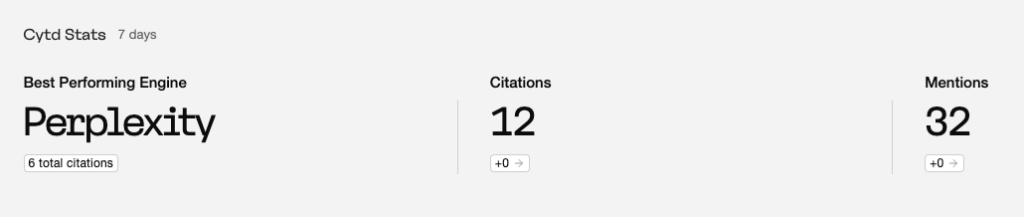
A citation means the AI linked to your website in its answer. A mention means the AI named your business but didn’t link to it. Both are good signals that you’re part of the answer.
In your dashboard, these appear as C and M. So if you see “C2 / M4” under a platform, that means it referenced you six times: twice with a link, four times by name.
Why Scores Move (and Sometimes Don’t)
A few things worth knowing so a quiet week doesn’t worry you.
Scores move in steps rather than a smooth line, because AI platforms re-crawl and reassess on their own schedule. A flat week is completely normal. A flat quarter is not, and that’s something your account manager will address directly.
Keep in mind the benchmark moves too. Your competitors are working on their own visibility, so holding steady sometimes takes real work.
And one thing worth understanding about how this works long term: your score is not permanent. The signals that earn citations decay over time, which is why the publishing and monitoring continue instead of winding down.
Still have questions? Reach out to support@cytd.ai