When someone needs a service or product like yours, they increasingly skip the traditional search bar and ask an AI assistant instead. “Who’s the best roofer near me?”“What should I look for when hiring a bookkeeper?” These are the questions people type into ChatGPT, Gemini, Perplexity, and Claude, and they’re where a lot of buying decisions now start.
What matters for your business is whether your brand shows up in the answer. Your target questions are how we make sure it does.
What Are “Target Questions”?
Target questions are what potential customers are typing into AI tools while researching services or products like yours. Many of these people don’t know your business exists yet. The goal is to make sure your brand shows up as a trusted answer when they ask, whether they’re ready to buy today or just starting to look at their options.
Why They Matter
Everything Cytd creates on your behalf, including blogs, videos, and distributed content, is built around these questions. The more that content matches your target questions, the more likely AI platforms are to cite your business as a relevant, trustworthy source.
This also becomes a positive feedback loop where each piece of aligned content adds a little more authority, which in turn increases how often your brand appears in AI-generated answers over time.
The Three Types of Questions
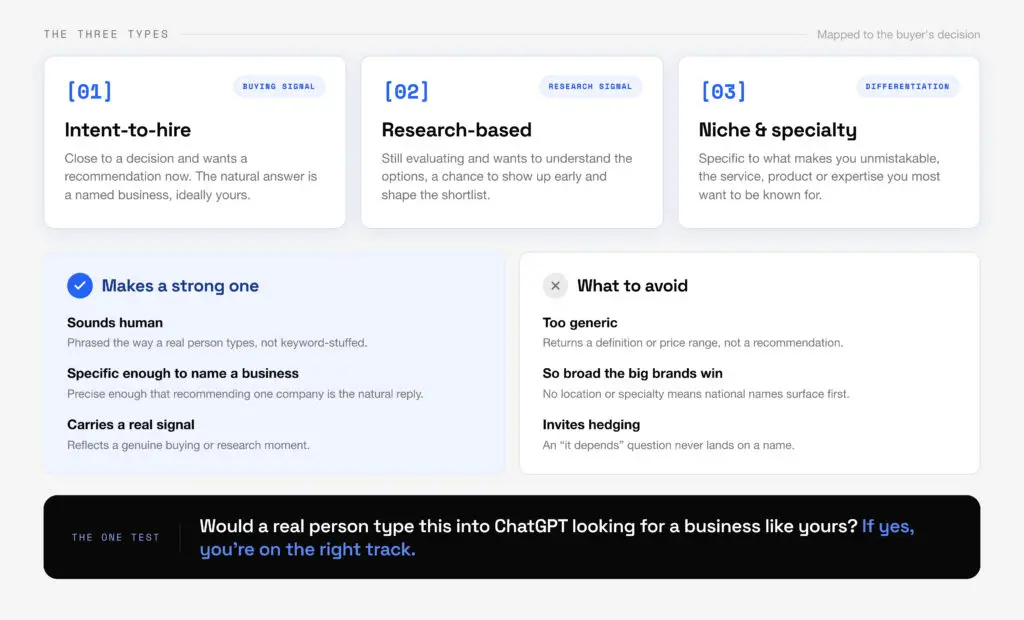
There are three types of Target Question, each tied to a different point in your customer’s decision.
One note on the examples below: they’re intentionally generic. They’re meant to show you the format and intent, not to be used as fill-in-the-blank templates (so don’t use them as such!). Your actual Target Questions should be tailored specifically to your business.
1. Intent-to-Hire
This person is close to a decision and wants a recommendation.
- “Who is the best [your service] in [your city]?”
- “Where can I find the best [your product] online?”
2. Research-Based
This person is still evaluating and wants to understand their options.
- “What should I look for when hiring a [your profession]?”
- “What should I look for when buying a [your product type]?”
3. Niche or Specialty
Specific to what makes your business unique, such as a service, product, or area of expertise you want to be known for.
- “Are there [your profession] that specialize in [your specialty]?”
- “Are there [your product type] made specifically for [your target audience]?”
What Makes a Good Target Question
The strongest Target Questions share three traits:
- It sounds like something a real person would type into ChatGPT. Natural phrasing works better than keyword-stuffing.
- It’s specific enough (without naming the business) that recommending a named business is the natural answer. The more precise the question, the more likely the AI is to point to a specific company, ideally yours.
- It carries either a buying signal or a research signal. A good Target Question reflects a real moment in the customer’s decision.
What to Avoid
It helps just as much to know which Target Questions won’t work:
- Too generic. The AI gives general advice instead of recommending anyone. “What is [your service]?” or “How much does [your product] cost?” return a definition or a price range, not a business.
- So broad that large national brands always win. You end up competing on the wrong terms. “What is the best [product type]?” with no location or specialty tends to surface big national names instead of a business like yours.
- Prompts that lead to hedging. If the question invites an “it depends” answer, you won’t get a clear recommendation. “Is it worth hiring a [your profession]?” pushes the AI toward general pros and cons instead of a name.
Before You Finalize a Target Question
Ask yourself one thing:
Would a real person type this into ChatGPT looking for someone like my business?
If the answer is yes, you’re on the right track.
See how AI sees your business
Enter your domain and get a free Cytd Score in under 30 seconds — you will see how ChatGPT, Gemini, Perplexity, Claude and Grok currently describe your business. No credit card required.
Get your free AI Visibility Report