

A business fails to show up in AI search results when AI platforms don’t have enough consistent, trustworthy, quotable information about it to recommend with confidence. AI assistants like ChatGPT recommend only 1.2 percent of local business locations, and ranking well on Google doesn’t fix it: less than half of businesses that win in traditional search ever appear in AI answers. The causes are specific and, in most cases, fixable.
This article breaks down the five reasons AI platforms skip over businesses, what the data says about each one, and what it actually takes to become the business AI names.
Your Customers Moved First
Before the reasons, the context that makes them urgent: the customers are already there. Forty-five percent of consumers used an AI tool to find a local business in the past year, up from just 6 percent the year before. AI assistants are now the third most common way people find local businesses, behind only Google and Facebook.

And the businesses those customers find convert. AI-referred traffic now converts 42 percent better than traffic from traditional search. The people asking AI aren’t browsing. They’re deciding.
How Bad Is the Visibility Problem?
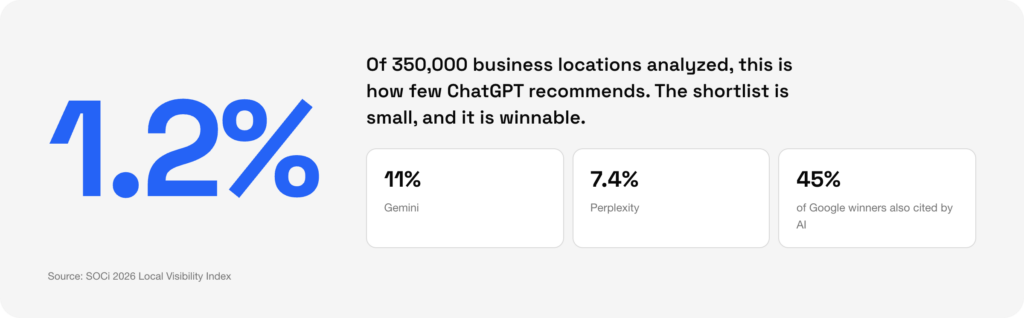
Worse than most owners assume. SOCi’s 2026 Local Visibility Index, which analyzed nearly 350,000 business locations, found ChatGPT recommends just 1.2 percent of them. Gemini recommends 11 percent and Perplexity 7.4 percent.
That makes AI visibility roughly 3 to 30 times harder to earn than a traditional local ranking. And the overlap between the two is thin: only 45 percent of brands that perform well in traditional local search also get recommended by AI. More than half the businesses winning at Google are absent from the answers their customers now ask first.
Reason 1: AI Doesn’t Have Enough Information About You
An AI assistant recommends a business when it has high confidence in the accuracy, quality, and reputation of that business. Confidence is built from data volume and consistency: your website, your business profiles, your reviews, your mentions across the web.
Businesses with incomplete profiles, thin websites, and inconsistent information fail that confidence threshold and get excluded entirely. This is the single most common reason for AI invisibility, and it compounds: a business AI knows little about doesn’t get cited, and a business that doesn’t get cited generates no new signals for AI to learn from.
Breaking that cycle starts with measurement. This is why cytd begins every engagement by auditing how each AI platform currently sees a business, scoring it across visibility, authority, and coverage, before any fixing starts. You can’t close a confidence gap you haven’t measured.
Reason 2: Your Information Is Inconsistent Across the Web
AI platforms cross-reference. ChatGPT’s local recommendations pull heavily from third-party data sources, with over 70 percent of local results drawing on Foursquare data, alongside Bing Places, Apple Maps, Yelp, and Google Business Profile. Gemini and Google’s AI Overviews lean on Google Business Profile as the backbone of local answers.
When your hours, address, service list, or even business name differ across those sources, the cross-reference fails. To an AI system, conflicting data doesn’t average out. It reads as unreliability, and unreliable businesses don’t get named.
Reason 3: Your Reviews Don’t Clear the Bar
Reviews function as a primary trust signal in AI recommendations, and the thresholds are higher than most owners expect. Analysis of ChatGPT’s local recommendation patterns shows businesses with 30 or more reviews at a 4.3-star average are the entry point, with 100 or more needed in competitive markets.
Recency and pace matter as much as volume. A steady flow of new reviews consistently outperforms a one-time burst followed by silence, and review response rate acts as an engagement signal in its own right. A business that stopped collecting reviews two years ago looks, to an AI system, like a business that stopped.
Reason 4: Your Website Gives AI Nothing to Quote
AI answers are assembled from quotable statements. If a website never plainly states what the business does, who it serves, where it operates, and what makes it different, there’s nothing clear enough to cite. Brochure-style sites built on slogans and stock photography are functionally invisible to systems that extract facts.
The same applies to trust content. A site with no about page, no team information, no service detail, and no evidence of expertise gives AI no reason to prefer it over a competitor that provides all of those things. This is also where machine readability matters: AI systems need to be able to crawl, parse, and understand a site’s content and structure to use any of it, which is why part of cytd’s work is optimizing the technical files and site structure AI systems use to read and understand a business.
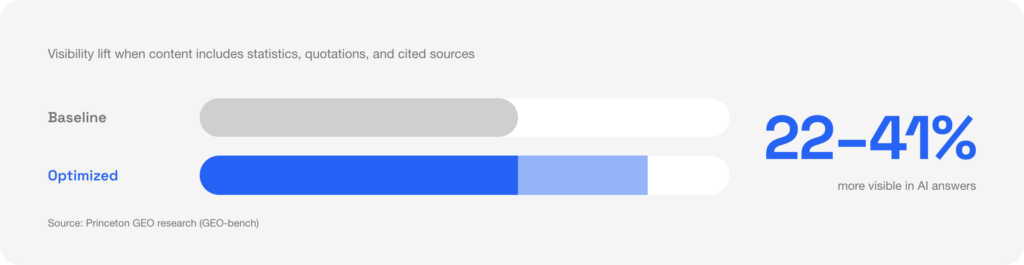
The fix on the content side is answering real questions, and the payoff is measured. The original Princeton GEO research found content built with clear statistics, quotations, and cited sources improved AI-answer visibility by 22 to 41 percent. That’s the method behind cytd’s content work: identify the specific questions a business’s customers actually ask AI, then build the quotable, evidence-backed answer to each one, tracked across ChatGPT, Perplexity, Gemini, Claude, and Grok.
Reason 5: You’re Absent From the Places AI Learns
AI systems don’t just read your website. They learn from the wider web, and some sources carry disproportionate weight. A 2025 analysis of over 150,000 LLM citations found Reddit cited in 40.1 percent of AI answers, more than any other source, with YouTube third at 23 percent.
A business with no presence in community discussion, no third-party mentions, and no off-site content has ceded those citations to whoever does show up there. AI assembles its picture of a market from what people say about businesses, not just what businesses say about themselves.
This off-site layer is a core part of how cytd builds authority for its customers: distributed content with backlinks from a highly indexable network, video presence on platforms like YouTube and Instagram, and placement in the third-party community discussions AI models draw on most, including Reddit.
What Actually Fixes It
The common thread across all five reasons is confidence. Every fix is a version of giving AI platforms more consistent, verifiable, quotable evidence that your business is a safe recommendation: complete and matching profiles, active review generation, a website that states facts plainly and can be read by machines, and a presence in the third-party places AI trusts.
This is the exact gap cytd was built to close, and each of the five reasons above maps to a piece of the work. The audit and score diagnose which factors are holding a business back. Question-driven content gives AI something quotable. Technical optimization makes the site machine-readable. Off-site distribution, backlinks, video, and community placement build the third-party trust AI platforms weight most. And ongoing tracking across ChatGPT, Gemini, Perplexity, Claude, and Grok shows exactly where citations are being won, all managed by a dedicated account manager rather than left to the business owner.
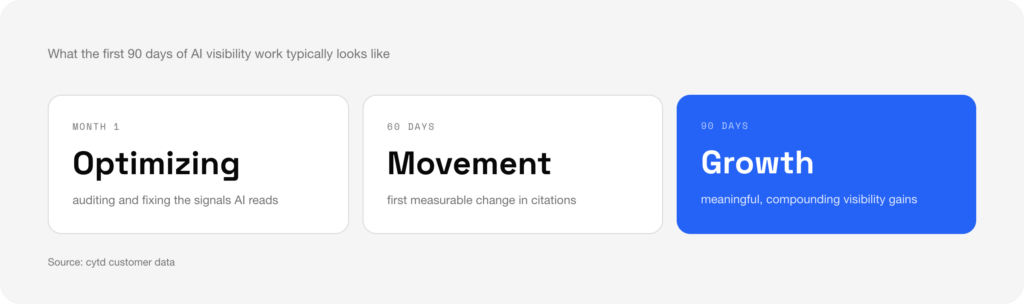
The starting point is usually humbling, and the trajectory is the point. Most businesses begin with an AI visibility score around 18 to 20 out of 100. With consistent work, initial movement shows within 30 days, and meaningful growth lands in the 60 to 90 day range.
Key Takeaways
- Forty-five percent of consumers used AI to find a local business last year, up from 6 percent, and that traffic converts 42 percent better than traditional search.
- ChatGPT recommends only 1.2 percent of local businesses, and only 45 percent of businesses that rank well on Google also appear in AI answers.
- AI platforms recommend based on confidence, built from consistent data, strong reviews, quotable content, and third-party presence.
- ChatGPT’s local answers draw heavily on outside sources like Foursquare, Bing Places, and Google Business Profile, so inconsistencies across them read as unreliability.
- The review bar is roughly 30+ reviews at a 4.3+ average, and 100+ in competitive markets, with recency and response rate counting too.
- Content built with statistics, quotes, and citations lifts AI visibility 22 to 41 percent, per Princeton’s GEO research.
- Most businesses start around 18 to 20 out of 100 on AI visibility, with measurable improvement typically landing within 60 to 90 days.
Frequently Asked Questions
Why does my business show up on Google but not in ChatGPT?
Because they run on different signals. Google ranks pages; AI assistants recommend businesses they have high confidence in, built from consistent profiles, reviews, quotable content, and third-party mentions. Only about 45 percent of strong Google performers also appear in AI answers.
How long does it take to start showing up in AI search results?
With consistent work on profiles, reviews, content, and third-party presence, initial movement is typically visible within 30 days, with meaningful gains over 60 to 90 days.
Do I need to advertise with AI companies to get recommended?
No. AI assistants build recommendations from public signals: your website, business profiles, reviews, and mentions across the web. Visibility is earned through data, not bought.
Which platforms should I care about most?
ChatGPT, Google’s AI Overviews and Gemini, Perplexity, Claude, and Grok together cover the large majority of AI search activity. Each weighs sources differently, which is why consistency across all of them matters more than optimizing for one.
What is an AI visibility score?
An AI visibility score is a 0 to 100 measure of how likely a brand is to be cited by AI answer engines, built from how visible, trusted, and broadly covered the brand is across the questions its customers ask. Most businesses start in the high teens.
Can I check how visible my business is right now?
Yes. cytd’s free AI visibility report shows where a business currently stands across the major AI platforms, and which factors are holding it back.
See Exactly Why AI Isn’t Recommending You
The specifics for your business are measurable. Get your free AI visibility score at cytd.ai and see exactly where you stand across ChatGPT, Gemini, Perplexity, and the rest, and what’s standing between your business and the answer.